
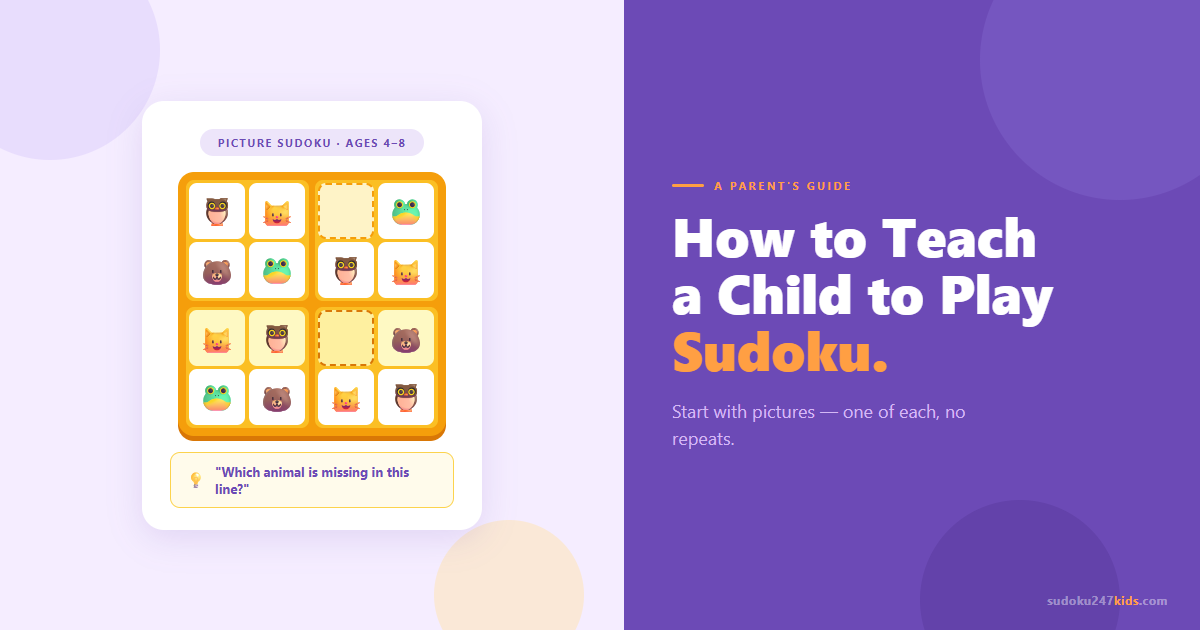
The easiest way to teach a child sudoku is to start small and stay gentle: begin with a picture puzzle or a tiny 4×4 grid, teach the one simple rule (“one of each, no repeats”), and praise effort instead of speed. Most children are ready somewhere around ages 4 to 6, and they learn best by playing alongside you — not by being timed or corrected. This is a calm, step-by-step way to get there, with a free grid to practise on at every stage.
When is a child ready to learn sudoku?
There is no magic age. Many children enjoy their first puzzles somewhere between 4 and 6 — earlier with pictures, a little later with numbers. The real readiness signs are simple: your child can match and sort things (“find the one that’s the same”), and they can sit happily with a quiet activity for a few minutes. If they can do a shape-matching game, they can do picture sudoku.
Numbers can wait. A young child who is still learning their digits has enough to think about, so pictures or colours let them practise the logic without the extra load of reading numerals. If you’d like a fuller age-by-age breakdown, our guide to logic puzzles for kids walks through what suits each stage.
Step 1: Start with picture sudoku
Begin with a puzzle that uses pictures instead of numbers. Picture sudoku swaps digits for friendly animals or shapes, so a pre-reader can play the moment they can tell a cat from a dog. It teaches the whole idea of sudoku — every group needs one of each — without asking your child to read at the same time.
Sit beside them and play one round together. Point to a row and ask, “Which animal is missing here?” Let them spot it and tap it in themselves. That single question — what’s missing? — is the heart of every sudoku they will ever solve. You can try a free grid right now with our picture sudoku for beginners.
Step 2: The one-of-each rule, in kid language
Sudoku has one rule, and a child only needs one sentence for it: each line and each little box gets one of each — no repeats. That’s it. You don’t need the words “row,” “column” or “region” on day one. Just point and name them in plain words: “this line across,” “this line down,” and “this little box.”
Teach it one piece at a time. Start with just the across-lines: “Every line going across needs all four animals, and you can’t have two the same.” Once that clicks, add the down-lines, then the little boxes. Bringing in all three rules at once overwhelms a young child; layering them lets each one settle before the next arrives. When they get one right, name what they did — “you found the missing one!” — so they learn the move, not just the answer.
Step 3: Move to a 4×4 grid
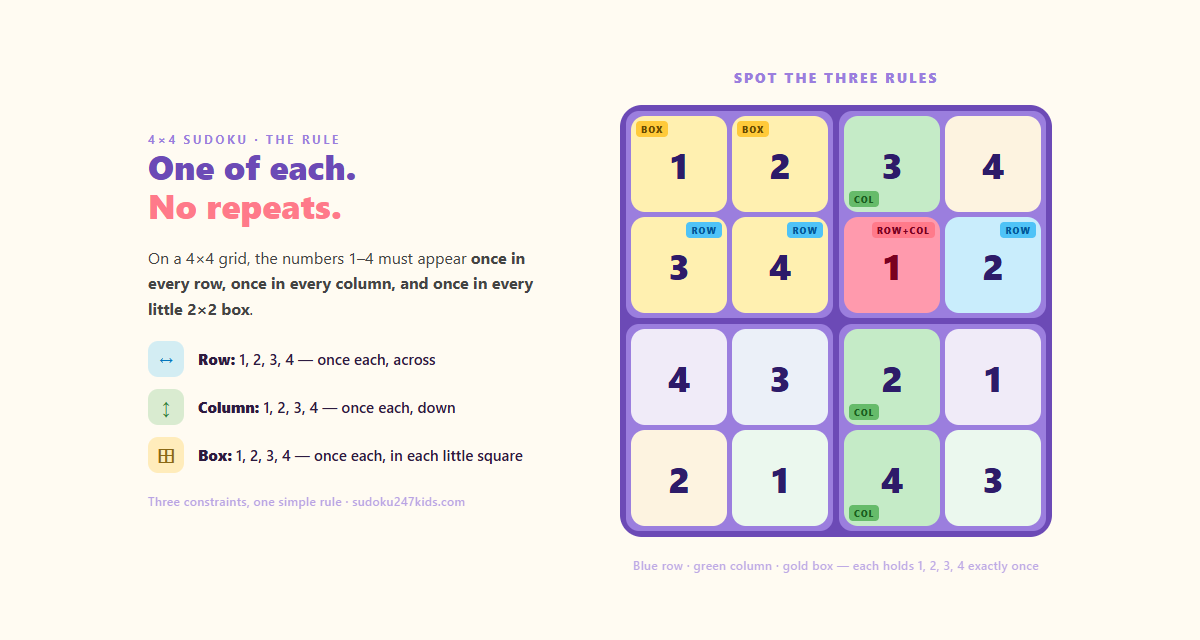
When pictures feel easy, swap them for numbers on the same small grid. A 4×4 sudoku uses only the numbers 1 to 4, in a grid of four lines across, four down, and four little 2×2 boxes. It’s the same rule your child already knows — one of each, no repeats — now with digits. The small size means a puzzle finishes in a minute or two, so wins come quickly and confidence builds fast.
Keep using the missing-number question, and keep letting them tap the answers in. If they stall, don’t give the answer — narrow the search instead: “Look at just this line. Which numbers are already here? So which one is left?” That nudge teaches them how to look. Practise on a free 4×4 sudoku for kids whenever they’re ready.
Step 4: Build up to 6×6
Once 4×4 puzzles feel routine, the next gentle step is a 6×6 grid. It uses the numbers 1 to 6 and slightly larger boxes (each one is two rows tall and three columns wide), so there’s a little more to scan and a little more thinking before each move. It’s a real step up, but not a leap — the rule and the way of looking are exactly the same.
Don’t rush the move. Stay on 4×4 until your child finishes them happily and mostly on their own. When they’re clearly ready for more, a 6×6 sudoku for kids gives them room to grow without a sudden jump in difficulty. From there, the full-size 9×9 puzzle is just the same idea, bigger — but that can wait for years yet.
Step 5: Encourage, don’t race
The fastest way to make a child love sudoku is to take all the pressure out of it. There’s no clock and no score to chase here — and there shouldn’t be at home either. Praise the thinking, not the speed: “I like how you checked the whole line before you decided.” That kind of praise teaches them that the careful looking is the point, and it’s what keeps them coming back.
A few small habits make all the difference:
- Stop while it’s still fun. Five happy minutes beats a frustrated twenty. End on a win and they’ll want to come back.
- Let them make mistakes. Spotting a repeat themselves teaches more than being corrected. Ask, “Is this animal anywhere else in the line?” and let them find it.
- Sit with them, not over them. You’re a fellow player asking questions, not a teacher marking answers.
- Celebrate the finish. A completed grid is a real achievement for a small child. Make a little fuss of it.
Go at your child’s pace, not a schedule. Some children fly through 4×4 in a week; others enjoy the same easy puzzles for a month. Both are completely fine.
More help for parents
That’s the whole method: picture sudoku first, then 4×4, then 6×6, with plenty of encouragement and no rush. If you’d like more on helping without taking over, when to start, and how to make puzzling part of family time, our parent’s guide to sudoku for kids brings it all together in one calm place.
Prefer paper to a screen? You can print a sheet to do at the kitchen table or pop in a bag for quiet time. Browse our printable sudoku for kids for free 4×4 and picture worksheets to take anywhere.
Frequently asked questions
What age can a child start sudoku?
Many children enjoy picture sudoku or a small 4×4 grid from around ages 4 to 6 — earlier with pictures, a little later with numbers. The signs of readiness are simple: your child can match and sort things, and can settle with a quiet activity for a few minutes. There’s no rush, and no “right” age. Start small and let it grow with them.
How long does it take a child to learn sudoku?
Most children grasp the one-of-each rule on a picture or 4×4 grid within a few short sessions, especially if you play alongside them. Becoming comfortable solving on their own usually takes a few weeks of relaxed, occasional play. Every child is different, so let pace follow enjoyment rather than a timetable — confident, happy play matters far more than how quickly they “get there.”
What if my child gets frustrated?
Frustration usually means the puzzle is a step too big, or the session has run too long. Drop back to an easier grid — from 6×6 to 4×4, or from numbers to pictures — and stop while it’s still fun. Instead of giving answers, narrow the search with a question like “which numbers are already in this line?” And remember there’s no clock here: a calm, unhurried five minutes beats pushing through a hard one.
Does my child need to know numbers to play sudoku?
Not for picture sudoku. It uses animals or shapes instead of digits, so pre-readers can play the logic without reading numerals first. That’s exactly why it makes such a good starting point — your child practises the spot-what’s-missing thinking now, and adds numbers later on a 4×4 grid when they’re ready.
More from the blog
- Number Puzzles for Kids: Fun Ways to Build Math SkillsFun number puzzles for kids that quietly build counting, logic, and pattern skills — with free 4×4 and picture sudoku grids to try at home or in class.
- Logic Puzzles for Kids by Age: A Calm Parent’s GuideA calm, ad-free guide to the best logic puzzles for kids by age — what each one builds, plus free picture, 4×4 and 6×6 sudoku your child can start now.
- Are Brain Games Good for Kids? A Calm Parent’s GuideA calm, honest look at whether brain games are good for kids — what the evidence shows, what to look for, and the free, ad-free puzzles worth their time.