
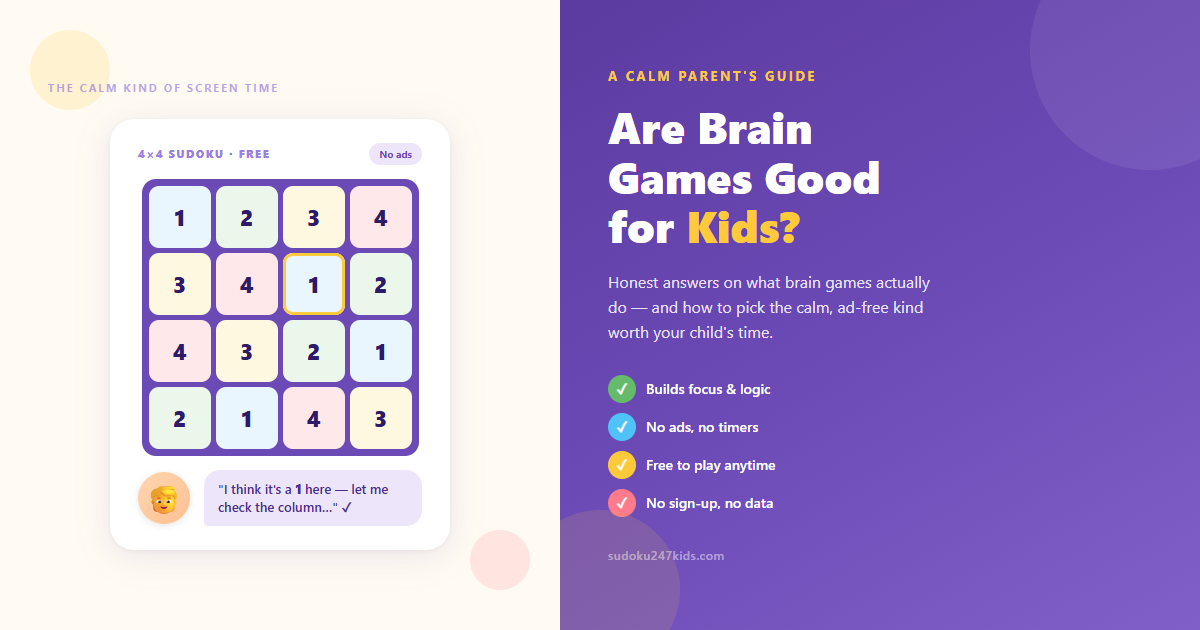
Yes — the right brain games are good for kids, but not in the way the flashy ads promise. A calm puzzle gives your child real practice at focus, logical thinking and working memory, and it can be a genuinely happy use of a quiet half hour. What the evidence does not show is that any game makes a child smarter overall, boosts their grades or works like medicine. Below we walk through what brain games honestly do, what to look for in a good one, and which calm, ad-free options are worth your child’s time.
Are brain games actually good for kids?
Good brain games help in small, specific ways, and they are not a magic shortcut to a cleverer child. Think of them as enjoyable practice for a few mental muscles — focus, logic and short-term memory — rather than a treatment or a head start.
Here is the honest picture. When a child works through a puzzle, they hold a few ideas in their head, look for patterns and reason one step at a time. That is real, satisfying mental effort, and it builds the calm, focused habit of sticking with a problem. The catch is something researchers call transfer: kids mostly get better at the game itself, and the skill does not automatically spill over into schoolwork or general intelligence. The Child Mind Institute puts it plainly, noting that for brain-training games “there just isn’t enough data to show that playing these games has a big effect on how well kids learn.” So it is fair to say a thoughtful puzzle is good for your child — just not as a shortcut to better grades.
That honesty is freeing, not disappointing. It means you can pick a brain game for the best reason of all: your child enjoys it, it keeps them quietly absorbed, and it sends the message that thinking hard can feel good.
What to look for in a good brain game
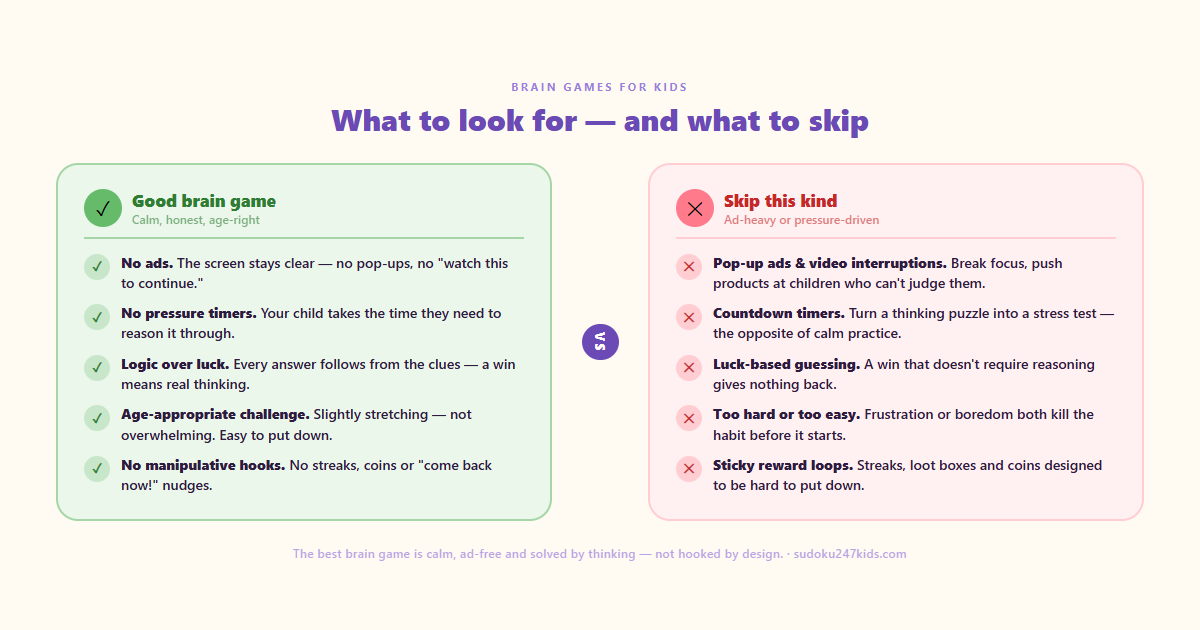
A good brain game respects your child — it keeps them thinking, not hooked. The difference is easy to spot once you know what to watch for.
- No ads. Pop-ups, video ads and “watch this to continue” prompts interrupt focus and push products at children who can’t judge them. A calm game keeps the screen clear.
- No pressure timers. A countdown turns a thinking puzzle into a stress test. Good brain games let a child take the time they need to reason it through.
- No manipulative reward loops. Streaks, coins, loot boxes and “come back now!” nudges are built to keep kids playing, not thinking. Skip anything designed to be hard to put down.
- Age-appropriate. The puzzle should stretch your child a little, not overwhelm them. A 4×4 grid for a five-year-old, a bigger grid as they grow.
- Logic over luck. The best brain games can always be solved by reasoning, never by guessing. That is where the real thinking practice lives.
This is exactly why we built our free, ad-free brain games for kids the way we did: clean grids, no ads, no countdown clock, and no streaks nagging your child to keep going. Every puzzle is solvable by logic alone, so a win always means your child worked it out — the calm kind of screen time, not the sticky kind.
What to be cautious about
The honest worry with “brain games” is rarely the thinking — it is everything bolted on around it. A lot of free apps earn money from ads and in-app purchases, which means the game is quietly designed to hold a child’s attention for as long as possible.
It also helps to keep screen time in perspective. The American Academy of Pediatrics has moved away from a single magic number of minutes, and instead asks parents to focus on the quality of what’s on screen, to watch and play alongside younger children where they can, and to make sure screens are not crowding out sleep, physical activity and free play. In their words, the goal is to keep media from “crowding out other important health behaviors, such as sleep or physical activity.” A short, calm puzzle fits comfortably inside that advice. A loud, ad-stuffed game that’s hard to switch off does not.
So the question to ask isn’t only “how long?” but “what kind?” A clear, friendly puzzle your child happily finishes and walks away from is a very different thing from a game built to never let them stop.
Brain games and brain teasers by age
Match the puzzle to the child, and almost any age can enjoy a good brain teaser. The trick is to start gentle and grow the challenge as their confidence does.
- Ages 4–6: tiny grids and picture puzzles. A 4×4 sudoku with shapes or colours is plenty — short, winnable, and full of small “I did it!” moments.
- Ages 7–9: bigger grids and simple logic teasers. A 6×6 puzzle adds a little more to hold in mind without becoming a slog.
- Ages 10+: the full 9×9 sudoku and trickier brain teasers, where real step-by-step reasoning starts to click.
If you’d like the full picture, our companion guide to logic puzzles for kids has a detailed by-age table and plenty of teaser ideas to grow into. It’s a good next read once you’ve found a puzzle your child likes.
Calm, ad-free options to try
The best brain game is the calm one your child actually wants to come back to. If you’d like somewhere to start that ticks every box above, here are two screen-friendly and screen-free ways to play.
- Play online, free and ad-free. Our calm sudoku for kids runs right in the browser with no ads, no timers and no sign-up — just clean 4×4, 6×6 and 9×9 grids your child solves by thinking it through.
- Go screen-free with a printable. If you’d rather skip the screen entirely, our printable sudoku for kids gives you puzzles to print at home for the car, the kitchen table or quiet time.
Want a little more background on screens, calm play and how we keep things simple? Our guide for parents explains the thinking behind the site in a few honest minutes.
Frequently asked questions
Are brain games good for a child’s focus?
They can be, in a modest way. A calm puzzle asks your child to settle in and concentrate on one thing, which is good practice for a young, easily distracted mind. The honest limit is that this focus mostly stays with the puzzle itself — it doesn’t automatically transfer to homework or chores. So enjoy a brain game as gentle focus practice, not as a guaranteed fix for attention.
How much screen time is okay for brain games?
There’s no single right number. The American Academy of Pediatrics now asks parents to focus on quality over a fixed time limit, and to make sure screens don’t crowd out sleep, physical activity and free play. A short, calm, ad-free puzzle your child happily finishes and walks away from fits that advice well. A loud game that’s hard to switch off is the part worth limiting.
What’s the best free brain game for kids?
The best free brain game is one that’s solvable by logic, free of ads and timers, and matched to your child’s age. Sudoku fits all three: it’s pure reasoning, it comes in 4×4 sizes for little ones up to 9×9 for older kids, and it never relies on luck. Our free sudoku for kids is built exactly this way — no ads, no clock, no sign-up.
Do brain games make kids smarter?
Not in the big way the ads suggest. Children do get better at the games they practise, but researchers have not found strong evidence that this carries over into higher intelligence or better grades. That’s the honest answer — and a good reason to pick a brain game your child genuinely enjoys, rather than one that promises to make them clever.
More from the blog
- Number Puzzles for Kids: Fun Ways to Build Math SkillsFun number puzzles for kids that quietly build counting, logic, and pattern skills — with free 4×4 and picture sudoku grids to try at home or in class.
- Logic Puzzles for Kids by Age: A Calm Parent’s GuideA calm, ad-free guide to the best logic puzzles for kids by age — what each one builds, plus free picture, 4×4 and 6×6 sudoku your child can start now.
- How to Teach a Child to Play Sudoku (Step by Step)A calm, step-by-step way to teach a child to play sudoku: start with picture puzzles, then 4×4, encourage not race — with free grids to practise at each step.