
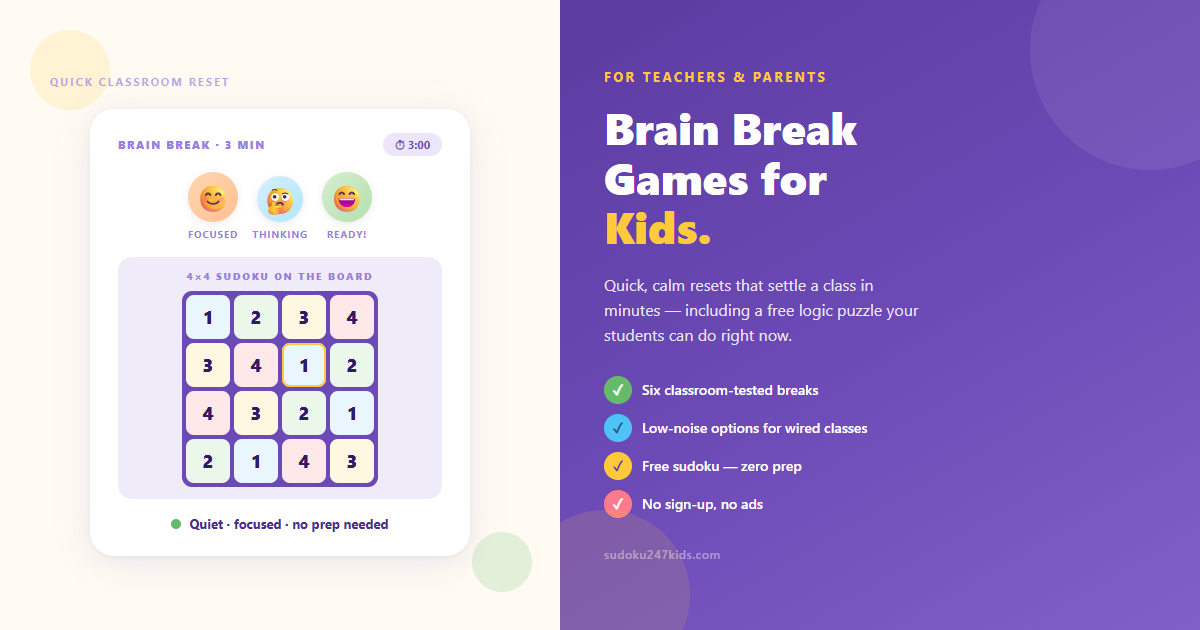
The fastest brain break games for kids are the quiet ones you can start in seconds: a silent thumbs-up round, a one-minute “freeze and breathe,” or a quick logic puzzle on the board. When a class starts to fizz or fade, a two-minute reset gets everyone back to ready. Below is a short, teacher-tested set of quick brain breaks — including the calm, low-noise ones that actually settle a room rather than wind it up.
What is a brain break (and why it works)?
A brain break is a short, deliberate pause — usually one to five minutes — that lets your students step away from a task and reset before they carry on. It is not a reward or a time-filler. It is a regulation tool.
Here is the simple reason it works. Young attention runs in spurts, not marathons. After a stretch of focused work, the room tips into either too much energy or too little. A brief, structured break nudges everyone back toward the calm, alert “ready to learn” zone — teachers and classroom-management coaches describe it as re-engaging the part of the brain that handles focus and self-control. You are not losing learning time. You are buying back the next twenty minutes of it.
The trick is matching the break to the moment. A restless, post-lunch class often needs to move. A wired, over-excited class usually needs the opposite — something quiet and grounding. That is why this set includes both.
Quick brain break games for the classroom
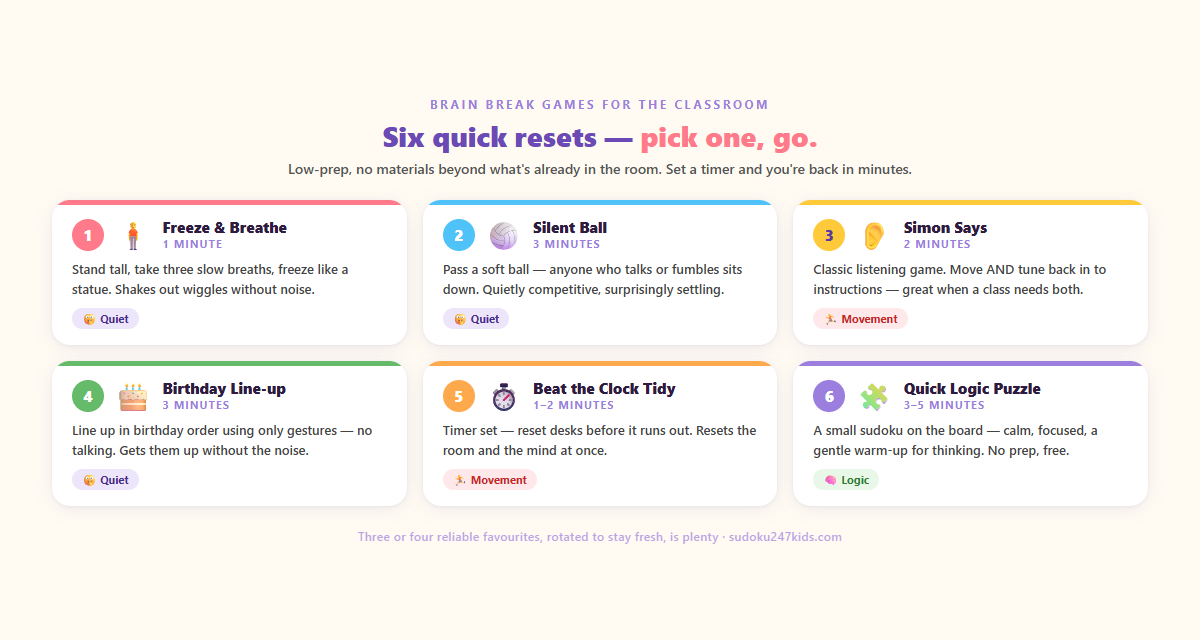
These are short, low-prep, and ready to run with no materials beyond what is already in the room. Pick one, set a quick timer, and you are back to the lesson in minutes.
- Freeze and breathe (1 minute). Students stand, stretch tall, then take three slow breaths and “freeze” like a statue. A calm way to shake out the wiggles.
- Silent ball (3 minutes). Pass or gently toss a soft ball around the room — but anyone who talks, fumbles, or makes a wild throw sits down. Quietly competitive, surprisingly settling.
- Simon Says (2 minutes). The classic listening game. Great for the moment a class needs to move and tune back in to instructions.
- Birthday line-up (3 minutes). Students line up in birthday order using only fingers and gestures — no talking allowed. A quiet challenge that gets them up without the noise.
- Beat the clock tidy (1–2 minutes). Set a timer and have the class reset desks and materials before it runs out. A reset for the room and the mind at once.
- Quick logic puzzle (3–5 minutes). A small sudoku or number puzzle on the board — calm, focused, and a gentle warm-up for thinking. More on this below.
You do not need fifty of these. Three or four reliable favourites, rotated so they stay fresh, are plenty. If you want more number-based options, our roundup of number puzzles for kids has gentle, screen-free ideas you can drop straight into the day.
Calm, quiet brain breaks for a wired class
When the room is already loud, the last thing it needs is a louder game. For an over-excited class, reach for a quiet brain break that lowers the volume and brings focus back. Logic puzzles are perfect here: a small sudoku asks for quiet, careful thinking, so it settles a room instead of stirring it up.
Sudoku also fits a real classroom need that most “games” miss — it is genuinely low-noise. Each child works at their own pace, scanning the grid and placing one number at a time. There are no winners shouting, no equipment to manage, and no clean-up. Just a few calm minutes of pattern-spotting.
You have two zero-prep ways to use it. You can pull up a free classroom sudoku on the board or a tablet for a quick group solve, or you can hand out printable brain break puzzles — kid-sized 4×4 and 6×6 grids your students can do at their desks with a pencil. Both are free, and neither asks children to sign up for anything.
If you are choosing puzzles by age, our pillar guide to logic puzzles for kids breaks down which formats suit which year groups, so the break stretches your students without frustrating them.
Using sudoku as a classroom brain break
Sudoku works as a brain break because it does one thing well: it asks for focused, single-task attention, then hands over a small win when a grid is solved. That little hit of “I did it” is exactly the reset a wandering class needs before moving on.
Keep it short and low-stakes. Three to five minutes on an easy grid is the sweet spot — long enough to settle and focus, short enough that it stays a break, not a lesson. Solve the first few moves together so nobody feels stuck, then let them finish at their own pace.
If brain breaks are becoming a regular part of your day, our sudoku resources for teachers gather the free puzzles, printables, and tips in one place — built for the classroom, with no accounts and no cost.
Frequently asked questions
How long should a brain break be?
Most brain breaks work best at one to five minutes. That is long enough to reset attention but short enough that the class slips straight back into the lesson. Movement breaks can be as quick as a minute; a quiet puzzle or colouring break can stretch to five. The key is to set a timer so the break stays a break.
What are some quiet brain break ideas?
For a wired or noisy class, try silent ball, a no-talking birthday line-up, finger breathing, quiet colouring, or a small logic puzzle like sudoku. These lower the volume and bring focus back, rather than adding more energy. A printable or on-screen sudoku is especially handy because every child works calmly at their own pace.
Are brain breaks just for younger kids?
No. Attention runs in spurts at every age, so a quick reset helps older students too — they simply need breaks that feel age-appropriate rather than babyish. Logic puzzles, quiet word games, and short movement challenges all scale up well from the early years through to upper primary and beyond.
Do brain breaks waste learning time?
The opposite, really. A short, well-timed break re-engages focus, so the work that follows is sharper and quicker than dragging a tired, restless class through it. You spend a minute or two to get back twenty good ones. The aim is regulation, not reward — match the break to whether the class needs to move or to settle.
More from the blog
- Number Puzzles for Kids: Fun Ways to Build Math SkillsFun number puzzles for kids that quietly build counting, logic, and pattern skills — with free 4×4 and picture sudoku grids to try at home or in class.
- Logic Puzzles for Kids by Age: A Calm Parent’s GuideA calm, ad-free guide to the best logic puzzles for kids by age — what each one builds, plus free picture, 4×4 and 6×6 sudoku your child can start now.
- How to Teach a Child to Play Sudoku (Step by Step)A calm, step-by-step way to teach a child to play sudoku: start with picture puzzles, then 4×4, encourage not race — with free grids to practise at each step.