
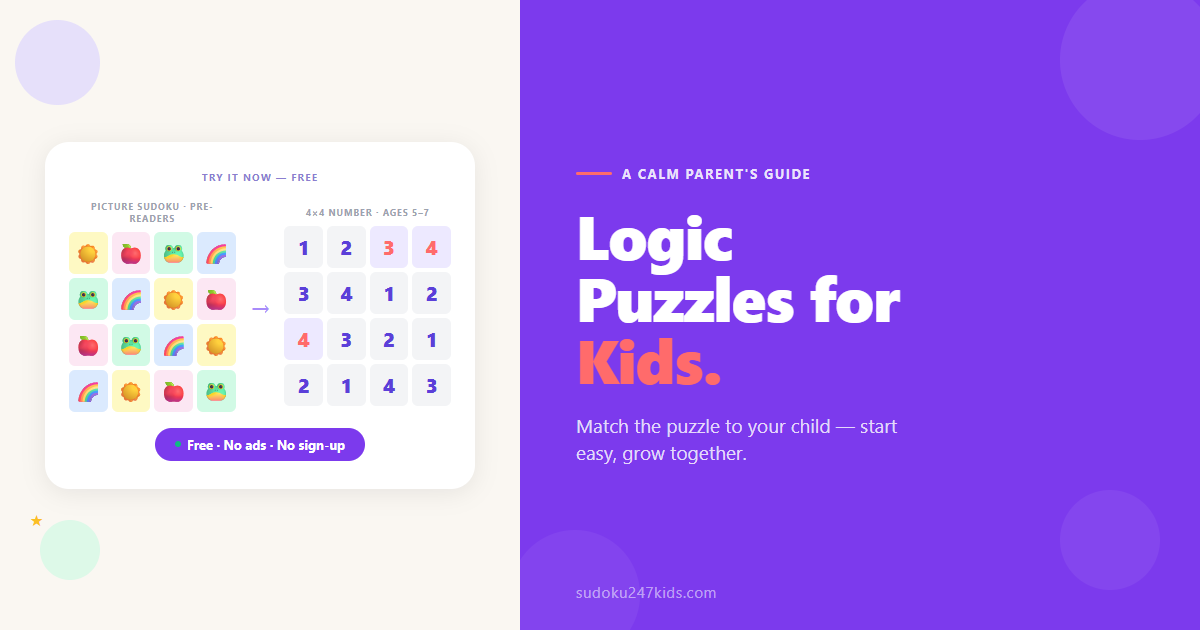
The best logic puzzles for kids are the ones that fit where your child is right now. A three-year-old who can’t read yet will light up at a picture puzzle, while an eight-year-old is ready for a grid full of numbers. This calm, ad-free guide sorts logic puzzles by age, explains what each one quietly builds, and gives you a free puzzle your child can start in one click — no signup, no ads, no rush.
If you only take one thing away: match the puzzle to the child, not the child to the puzzle. Start a little easy, let them win, and move up only when they’re ready. Below you’ll find a simple age-by-age path through picture sudoku, 4×4 grids and 6×6 grids — and answers to the questions parents ask most, including what age a child can start sudoku.
What counts as a logic puzzle for kids?
A logic puzzle is any puzzle a child solves by thinking it through, not by guessing or remembering a fact. The answer is already hidden in the clues — the child just has to reason their way to it.
That covers a lot of friendly, familiar things: spot-the-difference, simple mazes, sorting games, pattern sequences (“what comes next?”), and grid puzzles like sudoku. What they all share is one quiet message to a child: look carefully, and you can work it out yourself. There’s no luck involved, which is exactly why these puzzles feel so satisfying when a child cracks them.
Sudoku is one of the clearest logic puzzles for young children because it has a single, gentle rule — don’t repeat the same picture or number in a row, column or box — and every move follows from what’s already on the grid. That makes it easy to teach and hard to get “luckily” right, so a child really is reasoning.
What logic puzzles build in a child
Logic puzzles give a few real, everyday skills a gentle workout — mostly focus, patience and pattern-spotting. They’re a lovely, low-pressure way to practise thinking. It’s also worth being honest about what they don’t do, so you can enjoy them for what they are.
- Focus and attention. A good puzzle pulls a child into a quiet, single-task state for a few minutes. For a young, easily-distracted brain, holding that focus is great practice in itself.
- Pattern-spotting. The more they play, the faster children notice “that one’s already here.” Seeing patterns is a building block for early maths and reading.
- Patience and sticking with it. Puzzles teach that some things take more than one try — and that the second look often finds the answer.
- Planning and self-check. Children learn to slow down, look before they fill in a square, and notice their own mistakes.
This fits what child-development experts say about play in general. The American Academy of Pediatrics notes that play can improve children’s abilities to plan, organise and even support maths and language skills. The honest caveat: a puzzle won’t make a child “smarter” overall or raise their grades on its own. Think of it as one happy, healthy part of a varied childhood — not a brain-training shortcut.
Logic puzzles by age
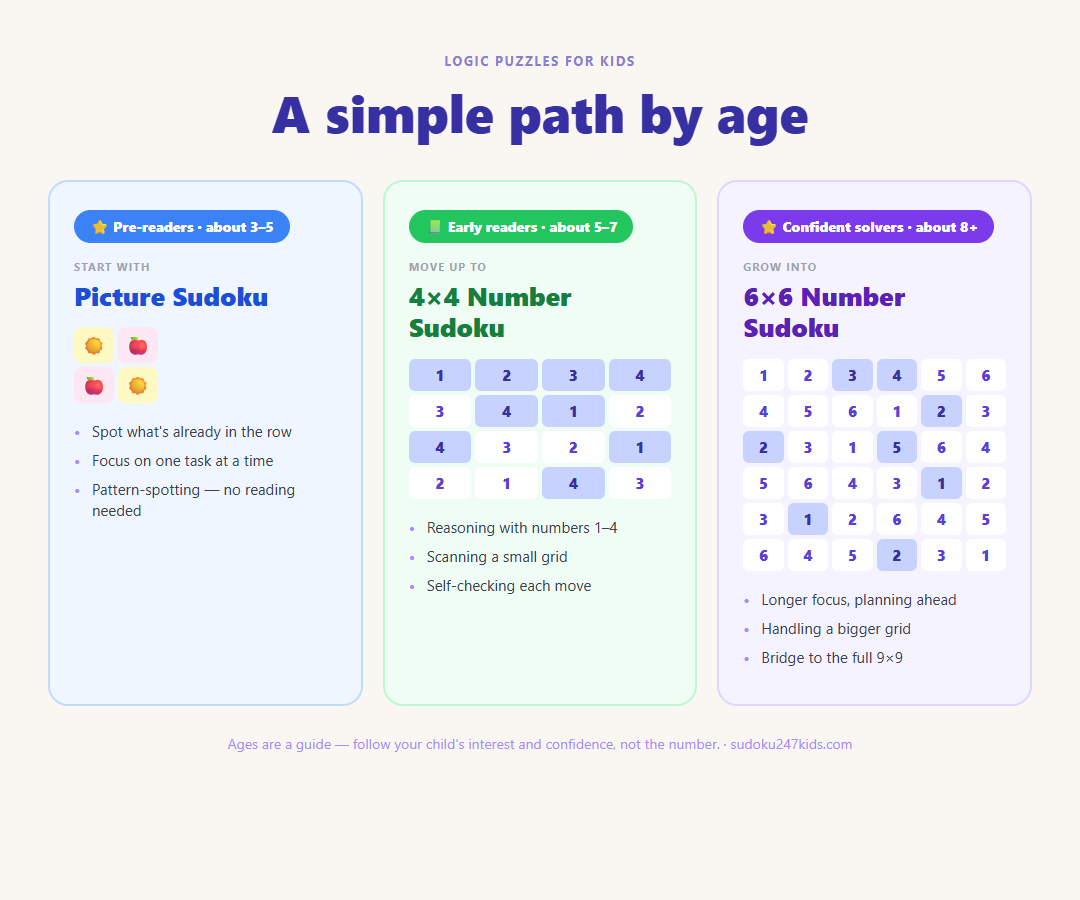
Here’s the simple path most children follow. Ages are a guide, not a rule — every child is different, so follow your own child’s interest and confidence rather than the number.
| Age band | Best puzzle to start | What it builds | Try it free |
|---|---|---|---|
| Pre-readers (about 3–5) | Picture sudoku (pictures, shapes or colours instead of numbers) | Pattern-spotting, “this one’s already here,” sitting with a task | Picture sudoku for pre-readers |
| Early readers (about 5–7) | 4×4 number sudoku | Reasoning with numbers 1–4, scanning a small grid, self-checking | Free 4×4 sudoku for kids |
| Confident (about 8+) | 6×6 number sudoku | Longer focus, planning ahead, handling a bigger grid | Free 6×6 sudoku for kids |
If your child finishes one level happily and asks for more, that’s your green light to nudge them up. If a puzzle brings frustration instead of fun, drop back a step — there’s no prize for rushing, and an early win keeps them coming back.
Picture sudoku for pre-readers
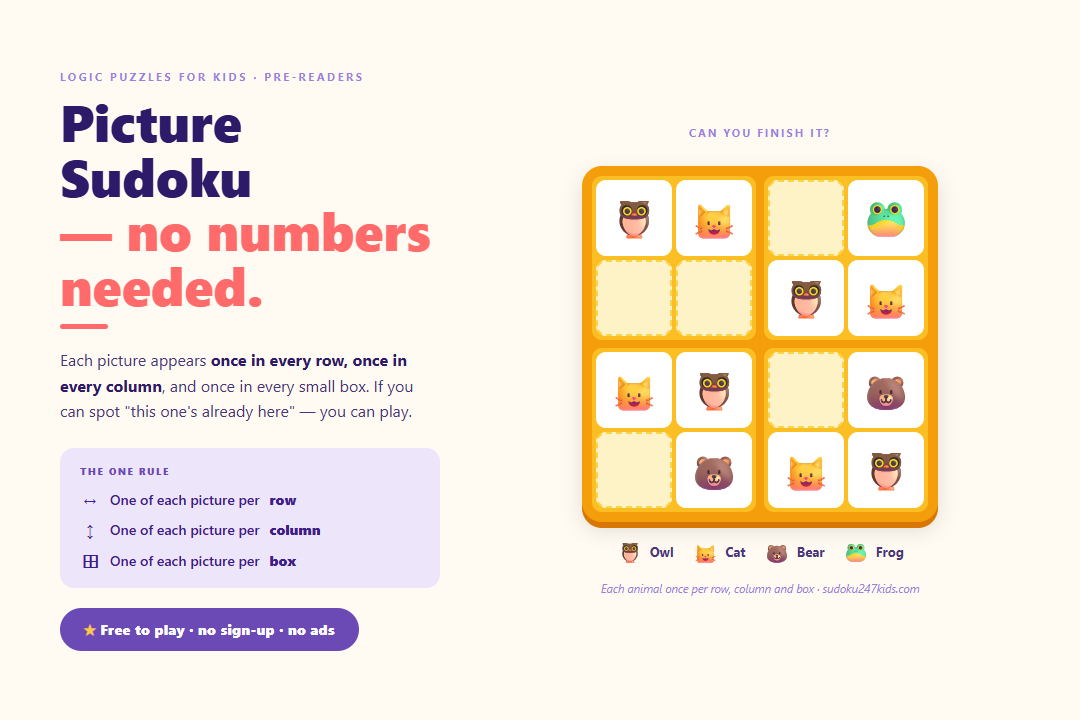
Picture sudoku is the perfect first logic puzzle for a child who can’t read numbers yet. It works exactly like grown-up sudoku, but with friendly pictures, shapes or colours — so the only skill a child needs is noticing what’s the same and what’s different.
The rule is wonderfully simple: each picture appears once in every row, once in every column, and once in every little box. A pre-reader doesn’t need vocabulary, counting or speed. If they can look at a row and see “the apple is already here, so it can’t go again,” they’ve grasped the core sudoku idea — and they’re reasoning, not guessing.
Sit beside your child for the first few. Point at a row, ask “is this picture already here?”, and let them place the answer. You can try it together right now with our picture sudoku for pre-readers — it starts in one click, with no ads and nothing to sign up for.
Number sudoku: 4×4 then 6×6
Once a child knows their numbers and can read, number sudoku is the natural next step — and a 4×4 grid is the gentlest place to begin. It uses only the numbers 1 to 4, so the whole puzzle stays small and winnable.
The 4×4 grid teaches the same one rule with numbers: each of 1, 2, 3 and 4 appears once in every row, column and box. Because there are so few squares, a child can hold the whole puzzle in their head and feel the satisfying click of a finished grid quickly. Start here with our free 4×4 sudoku for kids.
When 4×4 feels easy and your child wants a bigger challenge, step up to 6×6. It uses the numbers 1 to 6 on a slightly larger grid, which asks for a little more focus and a touch of planning ahead — a great fit for confident solvers around age eight and up. Our free 6×6 sudoku for kids is the bridge toward the full-size 9×9 puzzles they’ll grow into.
Printable logic puzzles for screen-free time
Sometimes you want a puzzle with a pencil and no screen — for the car, a quiet afternoon, or a rainy day. Printable logic puzzles are perfect for that, and you can print our kids’ grids for free.
Our free printable sudoku for kids makes fresh 4×4 and 6×6 grids you can print at home, as many as you like, with no signup and no ads. Print a few before a trip, keep some in your bag, or build a little weekly puzzle ritual — screen-free time that still gives those focus and pattern-spotting skills a gentle workout.
Want more ideas for bringing puzzles into family routines? Our guide for parents has calm, practical tips for getting started without any pressure.
Frequently asked questions
What age can a child start sudoku?
Many children can start a simple picture sudoku from around age three or four, using pictures or colours instead of numbers. Once a child can read and recognise the numbers 1 to 4 — often around age five or six — they can move on to a 4×4 number sudoku. Bigger 6×6 grids tend to suit confident solvers from about age eight. Ages are only a guide, though; the best sign your child is ready is that they’re curious and having fun.
Which logic puzzle is best for a pre-reader?
Picture sudoku is the best first puzzle for a child who can’t read yet. It uses pictures, shapes or colours, so the only skill needed is noticing what’s already in a row, column or box. If your child can spot that “the star is already here,” they’ve understood the core idea — and they’re solving by reasoning, not luck.
Are logic puzzles actually good for young kids?
Yes, in a gentle, everyday way. Logic puzzles give focus, patience and pattern-spotting a fun workout, and child-development experts agree that playful problem-solving supports skills like planning and early maths. The honest caveat is that no single puzzle makes a child smarter overall or boosts their grades. Enjoy puzzles as one happy part of a varied childhood, not a brain-training programme.
How long should a child spend on a logic puzzle?
Short and happy beats long and forced. A few minutes is plenty for a young child, and it’s completely fine to stop the moment the fun fades. Little and often — one small puzzle here and there — builds a habit far better than a long session that ends in frustration. Always let your child set the pace.
Are these logic puzzles free?
Yes. Every picture, 4×4 and 6×6 sudoku here is free to play and free to print, with no ads and nothing to sign up for. You can start a puzzle in one click and print as many as you like, so it’s easy to try a few and see what your child enjoys.
Daugiau iš tinklaraščio
- How to Teach a Child to Play Sudoku (Step by Step)A calm, step-by-step way to teach a child to play sudoku: start with picture puzzles, then 4×4, encourage not race — with free grids to practise at each step.
- Are Brain Games Good for Kids? A Calm Parent’s GuideA calm, honest look at whether brain games are good for kids — what the evidence shows, what to look for, and the free, ad-free puzzles worth their time.
- Brain Break Games for Kids: Quick Classroom ResetsQuick, calm brain break games for kids that reset a classroom in minutes — including free, low-noise logic puzzles your students can do with zero prep.